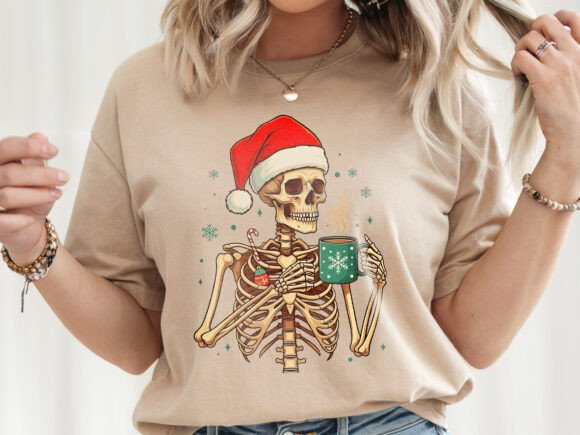
Dead Inside Skeleton Christmas Shirt
A Designer’s First Glance: Dark Humor, Clean Lines, Real-World Fit
When I opened the Dead Inside Skeleton Christmas Shirt file—just that one crisp PNG at 4500×5400 pixels, 300 dpi—I didn’t see a “funny holiday graphic.” I saw a silhouette with intention. The skeleton wears a tiny Santa hat, ribs subtly outlined, arms crossed in quiet resignation. No clutter. No snowflakes or tinsel competing for attention. It’s minimalist, but not sterile—it lands somewhere between wry and warm. That matters when you’re stitching it onto a hand-dyed organic cotton tote for a local boutique or embroidering it onto a baby sweatshirt for a holiday gift. This isn’t just a T-Shirt Designs asset; it’s a mood anchor. And moods stitch well—if you respect their scale.
Where It Shines: Embroidery Projects That Feel Intentional
I tested the Dead Inside Skeleton Christmas Shirt as an embroidered patch on heavyweight twill, then scaled it down for a child-sized apron and up for a crewneck sweatshirt front. It held up best where contrast and clarity mattered most: on medium-weight, stable fabrics like canvas totes, denim jackets, and unbrushed fleece. On a black cotton sweatshirt? The clean negative space around the skeleton made the stitch definition pop—especially with matte black thread over charcoal fabric. As a machine embroidery design, its open shapes translate beautifully into satin-stitched outlines and low-density fill stitches. No dense fills to pucker thin layers. No tiny antlers or holly berries to vanish under thread. That simplicity is a gift for craft business owners juggling dozens of holiday orders.
For Etsy sellers and small shop product creators, this design works especially well for curated collections: think “anti-cheerful holiday” bundles with matching tea towels, pillow covers, and enamel pins. I stitched it onto a linen-knit kitchen towel—moderate tension, tear-away stabilizer—and the result felt handmade, not mass-produced. Customers notice that difference. They’ll pay more for something that looks *designed*, not dropped in.
Where to Pause: Fabric, Scale, and Expectation
Don’t force the Dead Inside Skeleton Christmas Shirt onto stretchy jersey tees without testing. Its clean lines rely on stability—without proper cutaway stabilizer and careful hooping, the cross-arms and rib cage can distort on curved or thin surfaces like caps or baby onesies. I tried it on a lightweight ribbed knit onesie (size 3–6 months) and found the top half of the skeleton softened too much in stitch definition. Not unusable—but it needed re-digitizing for that scale and fabric. Same goes for dark fabric with light thread: preview your digital embroidery file in grayscale mockups first. What reads as bold on screen may blur when stitched with ecru on navy.
Also worth noting: because it’s delivered as a single PNG—not vector or native embroidery files—you’ll need to digitize it yourself or hire a digitizer before stitching. That means checking stitch density manually, confirming hoop size compatibility (I recommend minimum 5×7" for full clarity), and auditing small details like the hat brim and eye sockets. They’re legible at 300 dpi on screen, but fine features shrink fast under needle and thread.
Real-Life Use Case: A Boutique Holiday Tote Collection
Last week, I prepped three limited-run embroidered totes for a local gift shop’s “Holiday Unplugged” launch—each with a different dry-humor design. The Dead Inside Skeleton Christmas Shirt was the standout. Why? Because when stitched at 4.2" wide on natural canvas, it read instantly from across the room: witty, seasonal, but never juvenile. Customers didn’t pause to decode it—they smiled, snapped photos, and asked about the story behind it. That kind of engagement lifts perceived value. It also reinforces brand consistency for shops curating a specific tone: thoughtful, slightly irreverent, deeply handmade.
What It Adds—and What It Doesn’t Promise
This isn’t a flashy, glitter-heavy applique design. It won’t dominate a busy holiday sweater or compete with sequined trim. But it *does* elevate products where restraint signals quality: personalized gifts for creatives, custom apparel for indie bookstores, embroidered patches for band merch, or nursery decor for parents who prefer “cozy cynic” over “jingle bells.” It builds trust—not through polish alone, but through authenticity. When your customer sees that skeleton on their mug or pillow cover, they feel seen. That’s hard to replicate with generic clip art.
It doesn’t promise universal appeal—and shouldn’t. That’s fine. Your craft business thrives on resonance, not reach. If your audience leans into dry humor, nostalgic minimalism, or quiet holiday realism, the Dead Inside Skeleton Christmas Shirt fits like a well-worn sweater.
Practical Notes Every Embroidery Designer Should Check
- Test first: Stitch on scrap fabric matching your final garment’s weight and stretch.
- Confirm contrast: Run black-and-white mockups to assess how thread colors will read on light vs. dark backgrounds.
- Review stitch density: Especially in the rib area—overly dense fills add bulk and reduce drape.
- Stabilize wisely: Cutaway for knits, tear-away for stable wovens, fusible for lightweight linens.
- Inspect corners and curves: The Santa hat’s curve and arm angles are clean—but verify they digitize smoothly at your target size.
- Licensing check: Since this is a Graphics asset delivered as a PNG, confirm commercial use rights before selling finished embroidered products or bundling it into digital embroidery file packs.
In short: the Dead Inside Skeleton Christmas Shirt is a quietly confident design—best used where less really is more. It rewards thoughtful execution and respects the craft behind every stitch. For embroidery designers, Etsy sellers, and small shop owners building meaningful holiday collections, it’s not just another graphic. It’s a conversation starter, stitched to last.